Introduction
Arriving in Oxford as a new student is very different from visiting as a tourist.
The city moves at its own pace — ancient in its stone and traditions, modern in its daily life — and it only starts to feel manageable once you begin moving through it regularly.
In your first week, understanding Oxford does not happen all at once. It happens gradually, through small recognitions.
You find your way without checking your phone.
You return to the same café and recognise the counter.
You ask a question or order food in English without rehearsing the sentence first.
This guide is written for students who come to Oxford not as sightseers, but as temporary residents. Many are learning to live, study, and think in a new place — often in a new language.
You do not need to read this guide in one sitting.
Each place stands on its own. Return to sections as you need them during your first days in the city.
The twelve locations below are chosen to help Oxford make sense in that crucial first week. Some help you slow down and recover from travel and information overload. Others place you directly inside the academic heart of the city. A few introduce you to everyday Oxford — buying food, meeting friends, moving through neighbourhoods — so the city begins to feel lived in, not observed.
Taken together, these places guide you through a simple progression.
You land gently.
You learn how the city fits together.
You end the week feeling oriented, capable, and at home.

1. Christ Church Meadow
A Calm First Breath of Oxford
Christ Church Meadow is often where new students take their first real pause.
This wide green space sits beside the city centre, bordered by the rivers Cherwell and Isis. Open fields stretch under a broad sky. College buildings appear above the trees but never dominate the view. Longhorn cattle graze quietly. Boats move slowly along the water.
Nothing here demands your attention.
For many students, this is where arrival anxiety begins to fade. Travel fatigue softens. The pressure of orientation slows. Your pace starts to match the city’s.
The Meadow removes urgency. You do not need a plan. You can walk, sit, or simply look. Many students return here throughout their time in Oxford, using it as a reset when the city feels intense.
Standing in an open field, Oxford shifts from being impressive to being approachable. It begins to feel human-scaled.

2. University Parks
A Safe, Open Base
University Parks offer a large, uncomplicated space that quickly becomes familiar.
Students share this space with families, dog-walkers, academics, and local residents. You might see a casual cricket match, people reading on benches, or friends walking together after class. No one stands out. Everyone belongs.
For new students, this matters. When everything else is unfamiliar, the Parks remain open and predictable. They become a meeting point, a shortcut, and a place to think.
Walking here also helps you understand Oxford’s scale. From the Parks, you realise how close the city’s main landmarks are. Distances begin to feel manageable. You start trusting your sense of direction.
Oxford stops feeling like a maze and starts feeling like a connected place.
3. Ashmolean Museum
A Quiet Reset After Arrival
By the middle of your first week, your mind is often full. New systems, new people, and constant English can be tiring.
The Ashmolean offers a calm reset.
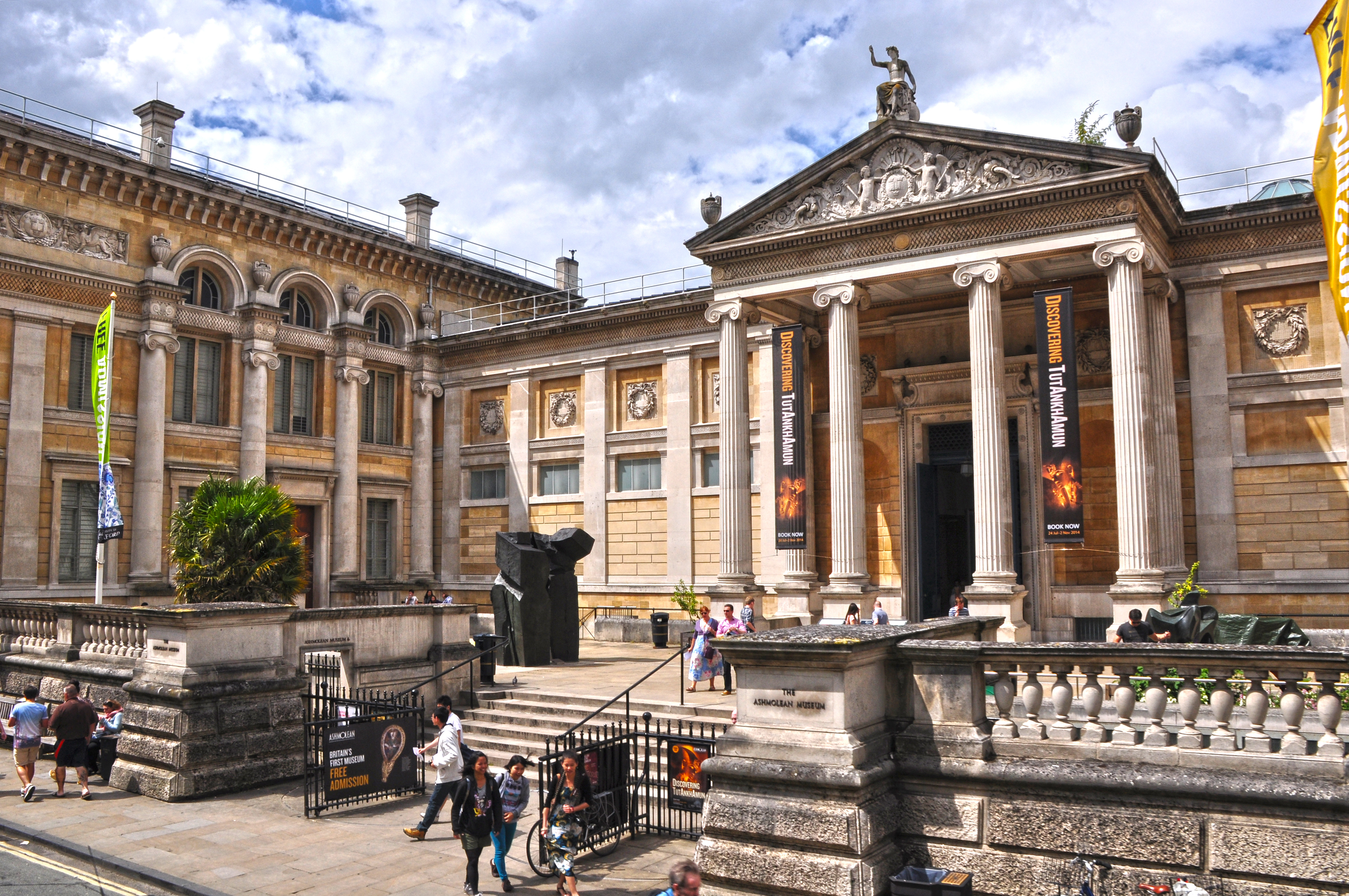
Light fills the galleries. The building is spacious and quiet without feeling formal. You can move slowly, pause when you need to, and leave whenever you like. There is no pressure to understand everything.
For international students, reading exhibition labels is a gentle way to practise academic English. The language is thoughtful but accessible. You are learning without realising it.
Many students visit briefly at first, then return later. It becomes a place to reconnect with curiosity rather than obligation.

4. High Street → Queen’s Lane → Radcliffe Square
The Walk That Makes Oxford Click
This short walk is one of the most important in your first week.
From the High Street, you turn into the narrow entrance of Queen’s Lane. Traffic noise fades. Stone walls rise close on either side. The lane twists gently, then opens suddenly into Radcliffe Square.
The change is immediate: busy street, quiet lane, open space.
Walking this route teaches you how Oxford works. The city does not reveal itself all at once. Its most important places are often hidden just off the main roads.
After walking this loop a few times, something shifts. You stop checking maps. You understand how streets connect. Oxford begins to feel navigable.
This walk becomes part of your internal map of the city.

5. Bodleian Library & Radcliffe Camera
The Academic Heart
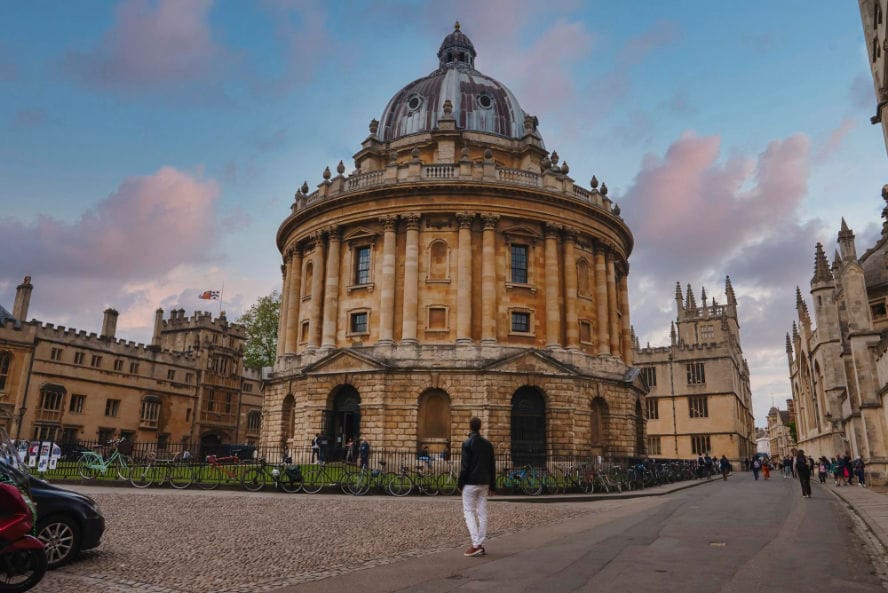
Standing in Radcliffe Square places you at the centre of Oxford’s academic life.
The Bodleian Library and the Radcliffe Camera are not symbolic buildings. They are working spaces. Students enter with books. Researchers leave at the end of the day. Knowledge here is active.
For many new students, this is a defining moment. Being in this square clarifies why you came to Oxford. You are not visiting a historic city. You are joining a living academic environment.
You also learn a new local language. People speak of “the Bodleian” or “the Rad Cam” as naturally as they speak of cafés or streets. Using these names without thinking is a small but meaningful step toward belonging.

6. Weston Library
An Open Door to Knowledge
Across Broad Street from the Old Bodleian sits the Weston Library, modern and welcoming.
Unlike traditional reading rooms, the Weston feels open and social. You can walk in freely, explore exhibitions, sit with a coffee, or read your own books.
For students new to Oxford, this is often the first comfortable connection to the university’s academic resources. You encounter rare books and manuscripts without needing special access. Conversations begin easily here.
The Weston demonstrates something important: Oxford’s knowledge is not sealed behind formality. It is meant to be engaged with.

7. Hertford Bridge
A Landmark You No Longer Notice (revised)
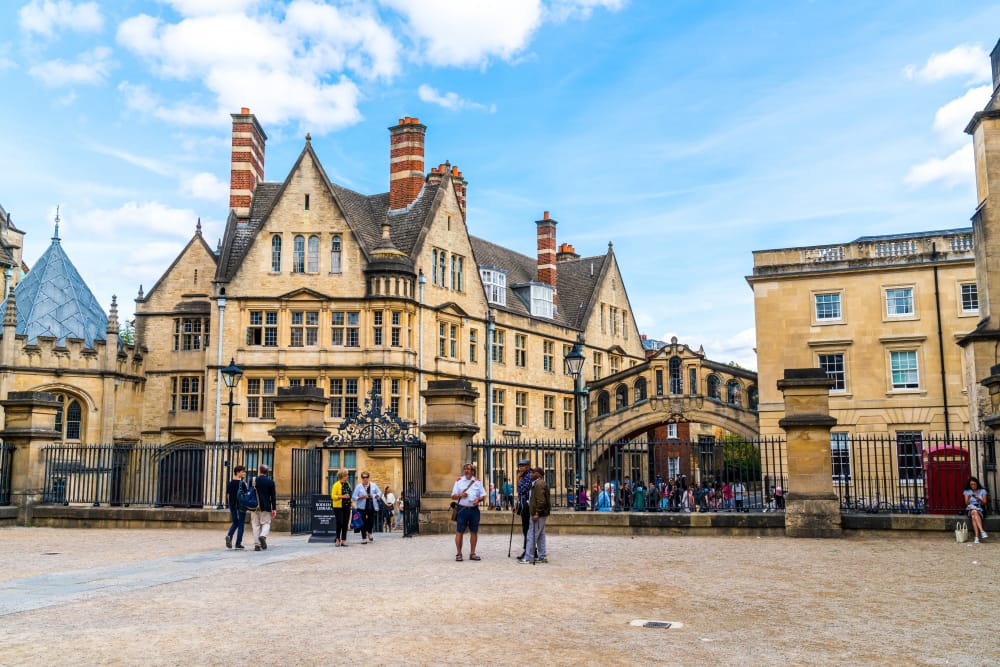
Hertford Bridge, often called the Bridge of Sighs, quickly becomes part of your everyday vocabulary.
Built in the early twentieth century to link two parts of Hertford College, the bridge deliberately echoes older European forms. Its enclosed stone arch feels far older than it is, which is typical of Oxford — the city often builds new things in conversation with its past.
You meet people “by the bridge.” You give directions using it. You pass beneath it without stopping.
That shift matters.
The moment you stop noticing the bridge as something remarkable, Oxford has begun to settle in your mind. A structure designed to connect academic spaces quietly becomes part of your daily movement through the city. The city’s history no longer feels distant or decorative; it supports your routine without asking for attention.
8. Oxford Covered Market
Where Oxford Becomes Practical (revised)
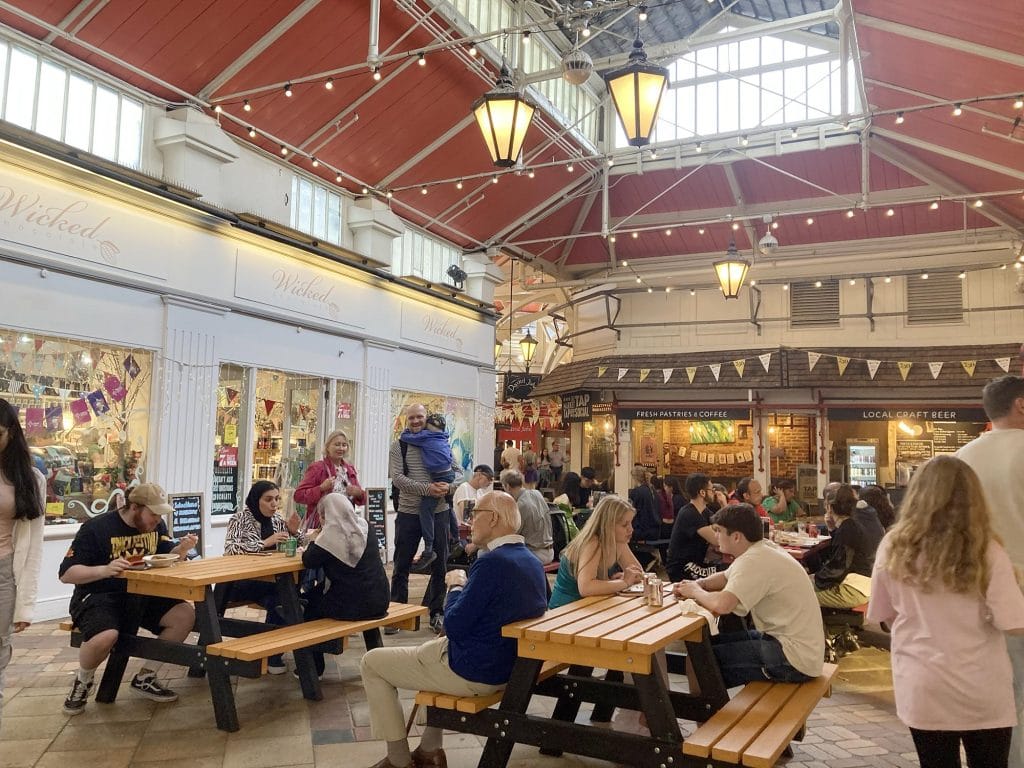
The Covered Market is where Oxford turns from academic to everyday.
Operating since the eighteenth century, the market was built to bring food, trade, and daily necessities into the centre of the city. That purpose has not changed. While the surrounding streets reflect centuries of academic life, the market has always served the practical needs of people who live and work here.
Here, you buy lunch, pick up small essentials, or handle everyday errands. Conversations are brief and real. English is used naturally, without preparation.
For many students, this is where confidence quietly grows. You respond quickly. You understand tone and rhythm. You stop translating in your head.
The market reminds you that Oxford has always been a working city as well as a scholarly one. Daily life has unfolded here for generations, and now you are part of that rhythm.

10. Carfax Tower
Seeing the City as One Place (revised)
Near the end of your first week, it helps to see Oxford all at once.
Carfax Tower stands at the historic crossroads of the city, where Oxford’s main roads have met for centuries. Long before colleges dominated the skyline, this was the centre of civic life — a place for announcements, bells, and public gathering.
From the top of the tower, streets connect. Landmarks align. Routes you have walked now make sense together.
This view often brings reassurance. Oxford looks compact. Walkable. Familiar.
Seeing the city from a structure that once served as its public heart quietly reinforces something important: Oxford is not just an academic environment layered onto a city. It is a city that has grown around learning, trade, and daily life. You descend with a clearer mental map — and a stronger sense of belonging.
.jpg)
11. Oxford Castle & Prison
Perspective Beyond the University (slight refinement)
Oxford’s story does not belong only to scholars.
The castle site traces nearly a thousand years of the city’s history, from Norman fortification to county prison. Long before Oxford was defined by colleges, this was a place of authority, control, and survival.
Encountering this history gives balance. The city becomes less idealised and more human. Lives here were not always comfortable or intellectual. They were practical, difficult, and shaped by power as much as learning.
Many students leave with perspective. Oxford has absorbed centuries of challenge and change. Your own first-week uncertainties feel smaller in that longer view.
_03.jpg)
12. Magdalen Bridge & the Riverside
A Softer Edge of the City (light historical touch added)
Standing on Magdalen Bridge, many students pause without planning to.
The bridge has marked this crossing point for hundreds of years, linking the city to meadowland and river paths beyond its walls. Scholars, traders, and residents have stood here long before punts became symbols of Oxford leisure.
By the end of your first week, this scene often feels different than it would have on day one. You recognise where the paths lead. You know which direction returns you to the city and which opens out into quieter spaces.
This is often when students realise how much has shifted. You navigate without hesitation. Conversations come more easily. Oxford feels smaller — not because it has changed, but because you have found your place within a city shaped by long continuity.
Closing Reflection
When Oxford Becomes Yours
Your first week in Oxford is shaped by small moments.
A route you remember.
A place you return to.
A sentence you speak without hesitation.
These twelve places support that process. They help you land, orient yourself, and connect with daily life. Over time, Oxford stops being impressive at a distance and becomes personal.
Walk the city. Revisit places. Let familiarity grow.
Oxford reveals itself step by step — and, in doing so, becomes yours.
Images used:
Image: Oxford – Christ Church Meadow Walk
by Txllxt TxllxT, licensed under CC BY-SA 4.0, via Wikimedia Commons.
Image: Engineering Science Building, 15 Mar 06
by KRC58, licensed under CC BY-SA 3.0, via Wikimedia Commons.
Image: Oxford – High Street – View North on Magdalen Tower
by Txllxt TxllxT, licensed under CC BY-SA 4.0, via Wikimedia Commons.
Image: Radcliffe Camera
by Kaofenlio, licensed under CC BY-SA 3.0, via Wikimedia Commons.
Image: Weston Library exterior on Broad Street
by John Cairns photography, work commissioned by the Bodleian Libraries, licensed under CC BY-SA 4.0, via Wikimedia Commons.
Image: Hertford Bridge
by Philip Halling, licensed under CC BY-SA 2.0, via Wikimedia Commons.
Image: Oxford Carfax NW
by Motacilla, licensed under CC BY-SA 4.0, via Wikimedia Commons.
Image: Oxford Castle by night
by Chris Wood, licensed under CC BY-SA 2.0, via Wikimedia Commons.
Image: Oxford – High Street – Magdalen College
by Txllxt TxllxT, licensed under CC BY-SA 4.0, via Wikimedia Commons.